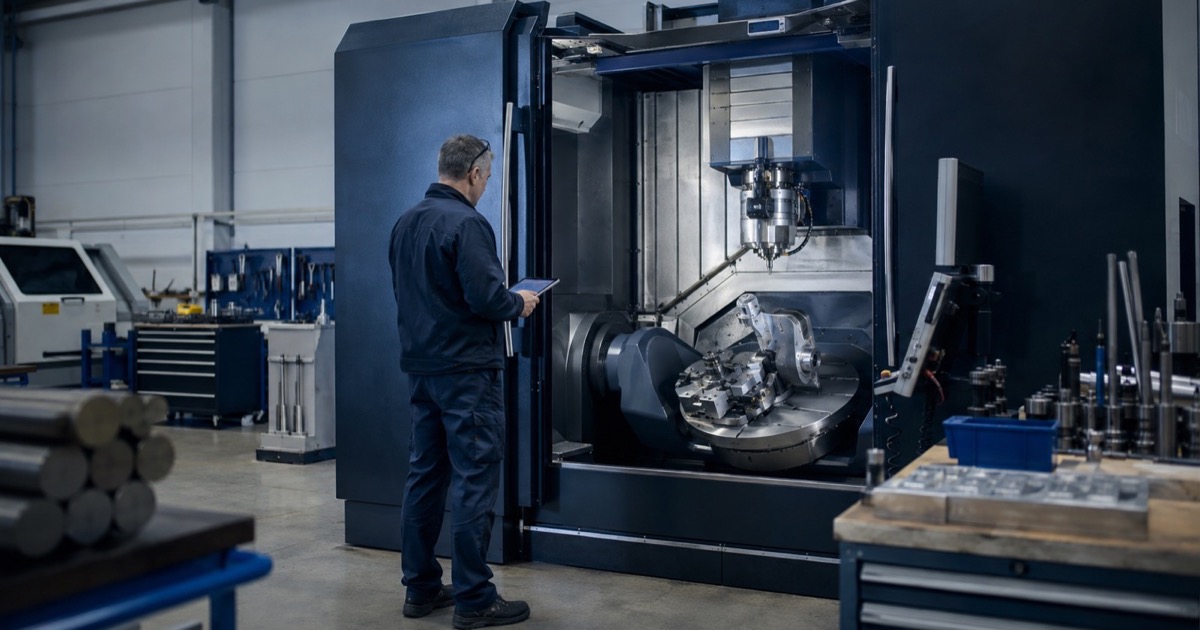
Ask a manufacturing director how long the business would be down if its most critical machine failed tomorrow and the answer may come back in weeks.
Ask the machine builder, maintenance specialist or replacement supplier for the current lead time on a genuine replacement and the honest answer may be measured in months—particularly for a specialist press, purpose-built extrusion line or five-axis machining centre built to order.
The dangerous part is not the difference between two estimates. It is that one of them may be an assumption while the other is based on the recovery route the business would actually have to follow.
That gap is where manufacturers get hurt: not only by the breakdown, but by a recovery plan that turns out to have been a guess.
About the examples: This article draws on anonymised real-world manufacturing situations. The recovery periods used are illustrative planning scenarios. They are not market-wide benchmarks and must be tested against the specific machine, supplier and operation.
A repair time is not a recovery time
Leadership teams often think first about how long a machine might take to repair. That matters, but it is only one possible route.
If repair is impossible or uneconomic, recovery could involve confirming the technical specification, obtaining quotations, securing finance, allocating a manufacturing slot, building or sourcing the equipment, arranging international transport, preparing foundations and services, installing the machine, commissioning it, proving the process, completing customer or regulatory approvals and gradually returning to normal output.
For bespoke or imported equipment, several of those stages may run sequentially rather than concurrently. Existing machinery may also be obsolete, meaning that the replacement is not truly like-for-like and the surrounding process may need to change with it.
Industry guidance on business-interruption planning makes the same point: machinery replacement can involve long lead times, followed by installation, commissioning and running-in before customer recovery is considered complete.
The question for leadership is therefore not simply:
How quickly can this machine be repaired?
It is:
How long would it take the business to restore the output, quality, approvals and customer service that depend on it?
Stress-test the assumption rather than defending it
Consider a precision-engineering business that assumes its critical machining centre could be replaced within three weeks. That may be achievable if the problem is repairable, the necessary part is available and the right specialist can attend immediately.
But an alternative planning scenario might be six, nine or twelve months if the machine requires replacement, importing, specialist installation and customer requalification. Those figures are not a prediction. They are a stress test designed to expose what leadership has not yet verified.
The business should not accept either estimate until it has obtained written information for its own equipment and mapped the entire recovery path.
This is not primarily a maintenance question. It is a leadership question.
A failure that interrupts production for three weeks is a difficult month. One that restricts output for six months can threaten customer relationships, cash flow, workforce stability and the viability of the business itself.
The board does not need to understand how to rebuild a hydraulic press or recalibrate a spindle. It does need to understand whether the business could withstand the period in which that asset produces nothing.
Downtime creates two losses at once
Every week of unplanned downtime can create two forms of loss that compound each other.
The first is immediate and visible:
- Lost output and contribution
- Expedited freight and specialist repair costs
- Temporary subcontracting at a premium
- Overtime, rework and disrupted production schedules
- Fixed costs continuing while productive capacity is reduced
The second develops more slowly and may be harder to reverse:
- Customers qualifying an alternative supplier
- Contractual penalties or missed delivery commitments
- Loss of preferred-supplier status
- Reduced confidence in future capacity
- Permanent movement of work to another source
In automotive, aerospace, food and other controlled supply chains, qualifying another supplier can require significant time and effort. Once a customer has completed that process, some of the displaced work may not return in full when the original machine is running again.
Recovery therefore means more than replacing an asset. It means recovering the commercial position that depended on it.
The insurance period must be tested against the operational reality
Business-interruption arrangements commonly include a maximum indemnity period: the maximum period for which the policy can respond to an insured interruption, subject to its terms, limits and triggers.
That period does not automatically extend because machinery takes longer to replace, a site requires alteration or customers take longer to recover. If leadership assumes twelve months of recovery support while the realistic route back to normal trading takes eighteen months, the business may face a material gap between its operational recovery and its financial protection.
The precise response will depend on the policy wording and cause of the breakdown. Machinery failure does not automatically mean that every business-interruption policy will respond. The purpose of the exercise is to establish the operational facts first, then ask the broker or insurer to test the current arrangements against them.
Published insurer guidance similarly recommends allowing for the time needed to repair or replace critical plant, rebuild inventory, execute continuity plans and recover lost revenue when setting an indemnity period.
Warning signs that the recovery assumption is weak
- No one has obtained a current written repair and replacement lead time for the specific critical machine.
- The business-interruption indemnity period has not been reviewed since the machine was installed or the operation materially changed.
- There is no documented contingency covering subcontract capacity, alternative machinery, rental, leasing or production transfer.
- Critical spares are single-sourced, held overseas or dependent on the original manufacturer.
- Only one or two people genuinely understand how to operate, diagnose or recover the machine.
- The declared value reflects the historic purchase price rather than a recently tested replacement figure.
- The recovery plan ends at installation and does not include commissioning, process proving, customer approval or the return to full output.
Six questions leadership should answer
- What is the current written repair and replacement lead time for our single most critical machine?
- Does our recovery estimate include specification, manufacture, transport, installation, commissioning, approval and ramp-up?
- What happens during the first 48 hours if that machine stops tomorrow, and who owns each decision?
- Which customers, programmes and delivery commitments would be affected first?
- Which spares, technical skills, software, tooling or external specialists could shorten the interruption?
- Do our continuity plans, declared values and insurance arrangements reflect the same recovery scenario?
Five actions to take now
- Ask the OEM, maintenance provider or specialist supplier for current written repair and replacement information for the specific machine.
- Map the complete recovery route, including installation, commissioning, process validation, customer approval and return to normal output.
- Document the first-48-hours contingency: decision owners, emergency contacts, alternative capacity and customer communications.
- Review critical spares, single-source components and access to the specialist knowledge needed to diagnose and recover the equipment.
- Take the evidenced recovery scenario to the broker or insurer and test it against the maximum indemnity period, values, limits, triggers and policy wording.
The InduX view
A critical machine is rarely an isolated engineering asset. It can connect operational resilience, financial exposure, customer concentration, specialist people, supply-chain dependencies and claims defensibility.
The useful question is not whether the machine is well maintained. It is whether leadership understands the consequences if maintenance is no longer enough.
Start with the real recovery timeline. Then decide what should be reduced, transferred, prepared for or escalated.
Sources
- Aviva — Selecting the right maximum indemnity period
- Allianz — Setting indemnity periods: why it is crucial to get it right
This article provides general information and does not constitute insurance, legal, engineering or other professional advice. Insurance coverage depends on the relevant policy terms, conditions, limits and circumstances.